The Cape Country Meander

  • Botrivier

    A pretty river town that's home to one of the oldest hotels in South Africa.

  • Caledon

    Famous for its mineral-rich hot water springs, which were first discovered by the Khoi-khoi.

  • ELGIN (GRABOUW)

    Farm-fresh produce, apples, roses, and the best cool climate wine-producing region in the country.

  • Genadendal

    A beautifully preserved hamlet full of atmosphere and history.

  • Greyton

    Ye Olde English country village with lively street-side stores and cafés.

  • Riviersonderend

    Rural simplicity with spectacular valleys, mountains, canyons and waterfalls.

  • Tesselaarsdal

    A secluded hideaway so hidden, in fact, that it doesn't appear on certain maps.

  • Villiersdorp

    Perfectly positioned for water sport, nature and wine enthusiasts.

Monday, 25 August 2014

What Elgin (Grabouw), Shakespeare and Eminem Have in Common

The apple appears to have been around since ancient times. It’s referenced in religion, myths, legends, fairy tales and folklore throughout the ages. Singers from Frank Sinatra to Eminem have sung about them. Poets such as William Blake and Robert Frost wrote about them. This plump little specimen has even featured in Shakespeare’s works. Remember that famous line from The Taming of The Shrew “There’s small choice in rotten apples”? In the Elgin Valley, Grabouw in the Overberg apples are practically revered and for jolly good reason too.

Inside a historical shoemakers cottage

The Elgin Valley is known throughout the world as the place where apples come from and generously produces 60% of the national crop. Elgin is home to Appletiser, the world famous “champagne of fruit juices” soft drink. And while you might not think of Elgin’s apple history as the most riveting way to occupy your mind, humour yourself, you might be pleasantly surprised.

Just off the main road in Grabouw town you’ll find the signposted Elgin Apple Museum in a historic shoemakers cottage. It’s one of only two apple museums in the world and offers a fascinating glimpse into the history of the apple industry.

Among the intriguing bits and pieces

The museum is packed with old photographs and displays from farming equipment to antique kitchen utensils. Find out how apples first came to the Cape. Get to know the stories of the early pioneers. Track the history of apple farming from the very first orchard in Elgin to the modern techniques used today. This little museum is filled with bits and pieces that depict how apple farming put a small community on the world map.

Opening hours and admission

Entrance is free, but donations are appreciated. The museum is adjacent to the Barrel & Beer Pub from which you can request the keys from the bar. Don’t forget to write your name in the guestbook before you leave.

If you ask your children, niece or nephew where apples come from, chances are they might rattle off the name of a retail store. What many people don’t know is that apples probably first came from Kazakhstan. In fact, the last surviving wild apple forests on earth are found there. Regardless, Elgin is by far South Africa’s largest apple producing region and proudly so. So, do take some time out from the area’s breathtaking countryside to do some historical apple browsing.

Monday, 11 August 2014

Why Everyone Succumbs to Pie Madness in Riviersonderend

There’s no need to scour the Overberg to find delicious, comforting pies made to thick or flaky, buttery perfection. Since the 1980s the Ou Meul Bakery in Riviersonderend has been producing crafted from scratch pie varieties that have made the place a hangout for locals and a must stop for cyclists and travellers passing through.

Who conjures the recipes?

Practice has certainly made pie-making perfect here. Certain favourite recipes have been passed down since the original owner, Tannie Rina, first introduced them. But the range has expanded somewhat, particularly under the guidance of current owner Antonie Basson, who took over in 2009.

The secret to a best-selling pie

Good pie is all about the crust. Ou Meul (Afrikaans for “old mill”) dough is made on site using fresh, local ingredients, all procured within a 15-kilometre radius. Pies are made with bio wheat, stone-ground, unbleached flour that’s preservative free and contain free-range eggs. While they do use machines to roll the dough - given the quantities that must be produced - all the puff pastry is rolled by hand.

Notice the wavy edge on the pie surface just like the good ‘ole days. As Antonie points out, “while we make a couple of hundred pies a day, most customers get to eat only one”, so each pie crust is painstakingly pinched by hand.

How to find Ou Meul Bakery

Finding the Ou Meul is easy. The N2 is the main arterial from Cape Town through to Mossel Bay and forms the main Road that cuts through Riviersonderend. If coming from Cape Town, you can’t miss the Ultra City filling station on your left as you enter the town, which, incidentally is owned by Antonie’s parents. Just next to that you’ll see the big Ou Meul sign and, on stepping out of your vehicle your nose will guide you the rest of the way.

More to the story

Ou Meul has an old fashioned heart with a contemporary twist. The famous pie range includes chicken, steak and kidney, mutton, spinach and feta, venison, *bobotie, and ham and cheese. They serve delicious coffees and other hot beverages too. Plus, you can order a sufficiently satisfying bacon and egg brekkie if you feel it’s too early for pie - although once you’ve had an Ou Meul pie it’s an all occasion and any time of day meal. One of the light lunch options is the popular Ou Meul Deluxe sarmie consisting of crisp lettuce, farm fresh chicken and mayo, bacon and avocado on handmade sour dough bread.

What an Ou Meul pie costs

Step up to the counter and make your pie selection to enjoy as a sit down or takeaway. The very reasonable pay-for-what-you-get prices range between R21 and R25 for a good size with a generous filling. You’ll also find homemade jams, preserves fresh baked breads on the shelves and under counter tasty sweet treat pastry confections. The jam tarts are spectacular and worth a whirl as are the on counter crunchies and chocolate chip bikkies.

Contact information

Ou Meul Bakery
27 Main Road, Riviersonderend
Open Monday to Friday (06:00 to 18:00), Saturday (06:00 to 15:00) and Sunday (07:00 to 18:00)
+27 28 261 1568
info@oumeul.co.za
www.oumeul.co.za 

Riviersonderend is the original Ou Meul pie shop but there are two other outlets:

14 Long Street, Cape Town
Open Monday to Friday (06:30 to 17:30) and Saturday (07:00 to 14:00)
+27 21 419 0062

G40 Willowbridge Lifestyle Centre, Durbanville
Open Monday to Saturday (07:00 to 18:00) and Sunday (08:00 to 17:00)
+27 21 914 0540

 *Bobotie is a typically South African dish consisting of spicy minced meat baked with a creamy egg-based topping


Friday, 25 July 2014

Lace Up For The Seventh Spur Cape Winter Trail Series™

Trail running is fast gaining in popularity in many countries and South Africa is no exception. There’s something special about the simplicity of it and that back-to-nature quality not found on city streets. Moreover, there’s no shortage of incredible country terrain in many parts of South Africa, so much so that the seventh Spur Cape Winter Trail Series™, presented by Wildrunner, is already underway. Best of all, part of it courses through our beloved Overberg.

Who can enter?

Starting at Paul Cluver Wine Estate in Elgin Grabouw last weekend there was some earnest competition at the front of the field. That said, this race, in addition to the obviously famous countryside really is an event for all sorts of running enthusiasts. There’s no need to be intimidated by the hardcore professionals. 

Novices are genuinely welcome to don their trainers for the sheer pleasure of running “wild” as it were. Just don’t be fooled by the challenge of loping over uneven natural terrain.

Fast fact for history buffs

Trail running might not be as new you would think. The first recorded hill race allegedly took place in Scotland in the bonnie year of 1040. It is said that the race was organised by the King to find himself a swift-footed messenger.

Regardless, you will often find the words “primal” and “dirty” associated with trail racing. Not to be confused with anything untoward, this kind of racing is unique, sometimes muddy, great fun and an ideal way to immerse yourself in pavement-less, crowd-less nature.

The rest of this year’s schedule

There are still a few online entries available for races 3 and 4. Alternatively, you can try your luck and get an on-the-day race entry between 06:00 and 07:30 for a measly R30 late entry penalty.

27 July: Race 2, Tygerberg Nature Reserve, Bellville
3 August: Race 3, Taal Monument and Paarl Nature Reserve, Paarl
16 August: Race 4 and XL, Kogelberg Biosphere, Kleinmond

For more information, to enter online or to keep up to date on full race reports visit www.trailseries.co.za. Follow Wildrunner on Twitter @WildrunnerZA and “like” the Facebook page at www.facebook.com/trailseries to get regular updates.

Images by: Mark Sampson, Spur Cape Winter Trail Series™

Wednesday, 2 July 2014

Overberg Bands Together To Save The Renosterveld


Of the once prolific renosterveld, a type of fynbos that covered the Western Cape’s fertile lowlands in the Overberg 300 years ago, a trifling 4-6% remains. The ramifications for biodiversity in this already critically threatened area are serious. All species from the humble, often seemingly scruffy little bushes to the immense diversity of bulbs and other flowering species, to the buck, insects, birds and humans depend on one another. The question then, can agricultural activities and conservation coexist?

Reaction from farmers

It is impossible to ignore that farmable land is becoming increasingly expensive. This in turn means that more of the renosterveld is ploughed. However, as Dirk Papendorp, himself a farmer and Chairperson of the of the board of the Overberg Lowlands Conservation Trust says, “... us farmers need to see there is an advantage to conserving the natural components of our farms”.

Farmers in particular can play a major role in conserving what’s left. Transformation of natural veld for farming land fragmented the land in the first place and left only tiny patches of renosterveld that the tractors and ploughs couldn’t reach. In fact, 99% of what’s left is precariously surviving on privately owned land, often labelled “uitvalgrond”, Afrikaans for wasteland on farm maps.

Overfarming fragmented the Renosterveld
The Overberg Lowlands Conservation Trust (OLCT)

In 2012, the OLCT was formed with a specific mandate to preserve the renosterveld. The organisation’s approach is pragmatic in the sense that they are not naively out to manage little isolated tufts of scrub. As Dr Odette Curtis, Project Manager of OLCT says, “... we want to work with farmers to manage living landscapes. If we manage in isolation we will lose it all anyway”. For a farm to be truly healthy and to have sustainable agricultural longevity the general habitat must also be healthy. This is a fact.

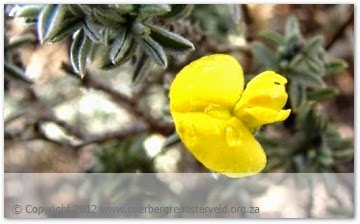
* New species: Hesperantha kiaratayloriae (critically endangered)
How achievable are the solutions put forward?

When farmers are shown what’s growing on their land, when they are made to understand that development does not necessarily imply ploughing; that a tiny species the only one of its kind in the world is grown on his farm and maybe a few others, he starts to see things from a new perspective. Conservation is a consequence of awareness.

That said the OLCT intends to do more than just change perspectives. They are also actively looking for practical ways to help farmers to manage their farms differently by providing viable economic incentives. Moreover, in the relatively short time the trust has been in existence they have already discovered six new species.


* New species: Polhillia curtisiae (critically endangered)
See this profoundly moving video

Local farmers in the region and representatives from the OLCT talk in candid terms about the renosterveld. In particular, one of the farmers, a man called Hansie Swart speaks about the horror of handing a paintbrush to a child to paint over the Mona Lisa. Similarly, he says the renosterveld, which took millions of years to evolve is also a kind of Mona Lisa. It’s bizarre then that we think we can bring our destructive paintbrushes (ploughs) to “paint” all over it. Even if you don’t reside in this particularly beautiful (and from a biodiversity perspective, sacred) part of the world, you can also do your part to preserve this and other living landscapes.

To find out more, to volunteer or make a donation, go to the Overberg Lowlands Trust website www.overbergrenosterveld.co.za. Also see National Geographic article, Recognising the Renosterveld: Biodiversity in Peril by Evan Eiffler.

* Species images copyright 2012 www.overbergrenosterveld.org.za

Monday, 23 June 2014

Best Place to Spot the Blue Crane


Twitchers and visitors in general often ask about the best spots to view the blue crane, South Africa’s national bird. Sadly, there’s nothing national about this beautiful creature because it is officially vulnerable. However, sightings in the Overberg are fairly common nowadays, owing to the efforts of various bodies, most notably the Overberg Crane Group (OCG) and a growing number of local farmers, striving to protect not just the blue crane but also what’s left of the living landscape, which forms part of its habitat.

Blue crane country

While the blue crane is more of a lowveld grassland (short grass) species it has adapted to the Overberg wheat belt. Unfortunately, owing to lack of information and over farming much of its natural habitat has been destroyed. In the 1970s, in particular, excessive cultivation of land, lack of control of pesticides and poisoning resulted in a severe population decline.

Of the approximately 25 000 Blue Crane left in South Africa, more than half are found in the Overberg. Like most species that have no choice but to adapt or die, these incredible birds have adapted to modern farming practices and can be seen right across the Overberg rural landscape.

Blue crane have adapted to modern agricultural practices

Best time of year

If you want to see them in open fields in pairs or with their chicks, then you need to be here in spring to summer. It’s also the time at which you need to be most considerate, by keeping a respectful distance. As summer fades and heads into winter, pairs with their growing offspring join other crane to form groups and can be spotted elegantly prancing and feeding in the fields. As winter progresses, birds become a little less predictable and start moving off in groups according to weather and available food. As they swirl gracefully into the sky their unmistakable high-pitched call, some suggest it’s more of a rattling croak, can be heard some distance away.

Why they need protection

The efforts to save and protect the blue crane and all bird life in the area means nurturing the landscape. Habitat loss is the single biggest through to South Africa’s national treasure. The blue crane as just one species forms an important part of the Overberg ecosystem, which is as diverse as the Amazon. Blue crane are also illegally traded for the domestic pet market and suffer severe injury and death from power line collisions and fence entanglements.

South Africa's national bird under threat

What you can do

Come to the Overberg to see and appreciate for yourself the regional diversity and these beautiful creatures, which, against all odds, have had the tenacity and adaptability to survive. If you spot a dead bird under a power line or suspect poisoning, contact the OCG. If on a nature walk you discover some rogue wire lying about, even if you cannot see a blue crane in the vicinity, pick it up, take it with you and disperse of it in a safe place.

Of the world’s six floral kingdoms, the Overberg is the world’s smallest, richest, and most diverse. Within this, the renosterveld, which forms part of the blue crane’s natural habitat, is the most threatened. Efforts are currently underway to protect the living landscape and local sentiment to do the same is on the increase. Failure to do so could see the blue crane going the same extinction route as the blue buck and the quagga in time to come.

Monday, 2 June 2014

New “Real Deal” Hermanus-Caledon Visitor Shuttle Service

Caledon in the Overberg is famous for it’s colourful wheat, canola and barley landscape, its history and natural warm mineral springs. It’s also well known for the Caledon Casino Hotel and Spa, the Overberg’s premier entertainment complex in which the springs are situated. That said, in order to make it easier and more convenient for you to get from Hermanus to Caledon, the Caledon Casino Hotel and Spa have put together a fabulous “Real Deal” package.

What your “Real Deal” includes

The package includes an entire hassle-free day of fun and fabulous taken care of from start to finish. For a reasonable R150 per person (Monday to Friday) and R200 per person (Saturday and Sunday) you get the following:

• 10:00 collection from Hermanus Tourism Office
• Short, picturesque journey through the Overberg (Hermanus to Caledon) with a qualified, experienced driver in a comfortable 23-seater, fully air-conditioned vehicle
• Select items lunch menu at Da Vincis Restaurant at the Caledon Casino Hotel and Spa
• Unlimited access to the natural, warm mineral springs (bring your bathing suit and prepare for some mineral R&R)
• R100 casino free play voucher
• 16:00 return to Hermanus

More value-added packages coming soon

The Caledon are in the process of putting together other special “Real Deal” value-added packages including travel, wine and dine events, live shows, and Spa pamper nights. And, with the overwhelmingly positive response similar shuttle trips are planned for other parts of the Overberg including the Elgin Valley (Grabouw), Greyton, Kleinmond, and Botrivier and possibly as far afield as Somerset West and Cape Town too. The official launch, the “Real Deal’s” maiden voyage, took place on Wednesday, 28 May 2014.

Get your ticket in advance

Tickets are available from Webticket direct and via the Hermanus Tourism Office and with enquiries pouring in it’s best to make your booking in advance. The Caledon is also taking block bookings for team building and corporate and private events. Part of letting your hair down and having some real fun means not having to worry about the drive there and back. For more information visit www.thecaledoncasino.co.za or contact 028 214 5100.

Wednesday, 7 May 2014

Tackling the Overberg's Youth Work Readiness Challenge

Education is important but it doesn’t guarantee employment or success. It’s the attitude, drive, entrepreneurial thinking and problem solving ability that goes with it that does. Lofty words perhaps, particularly in a climate of economic flux, uncertain career prospects, and a largely disillusioned youth; even more so for those living in abject circumstances in rural communities.

About the Biggest Deal Challenge

So, in order to actively address the problem, the Theewaterskloof Municipality has rallied together with the private sector to create the Biggest Deal Challenge, work ready youth development programme.

A great deal of preparation has gone into creating the 7 fun, business related tasks that will challenge young people from all walks of life to step out of their comfort zones and become courageous and confident entrepreneurs.

For young people aged 14-18

It really doesn’t matter if participants are in or out of school, as long as they have the attitude and drive to do something that is bigger than their environment and circumstances; and of course they must reside or go to school in the Theewaterskloof district. This includes the towns Bot River, Caledon/Myddleton, Genadendal, Grabouw, Greyton, Riviersonderend, Villiersdorp and Tesselaarsdal.

Like most things in life it’s a team effort

Participants must organise themselves into teams with a minimum of 3 and a maximum of 6 members, pick a business idea, and sign up. Thereafter, teams will receive a letter officially welcoming them to the challenge. They will also get to select from a list of business savvy mentors, an advisor if you will, to guide them at any stage of the process. There’s plenty of support and guidance throughout the initiative.

When it takes place and how to apply

Applying is easy. There’s no entrance fee. Application forms Form can be obtained from local schools, local municipal offices or completed on the Biggest Deal Challenge website. The closing date for applications is 17 May 2014. The challenge itself kicks off on Monday, 24 June 2014 and runs until the end of the school holidays. The winning team will receive a R10 000 cash prize.